
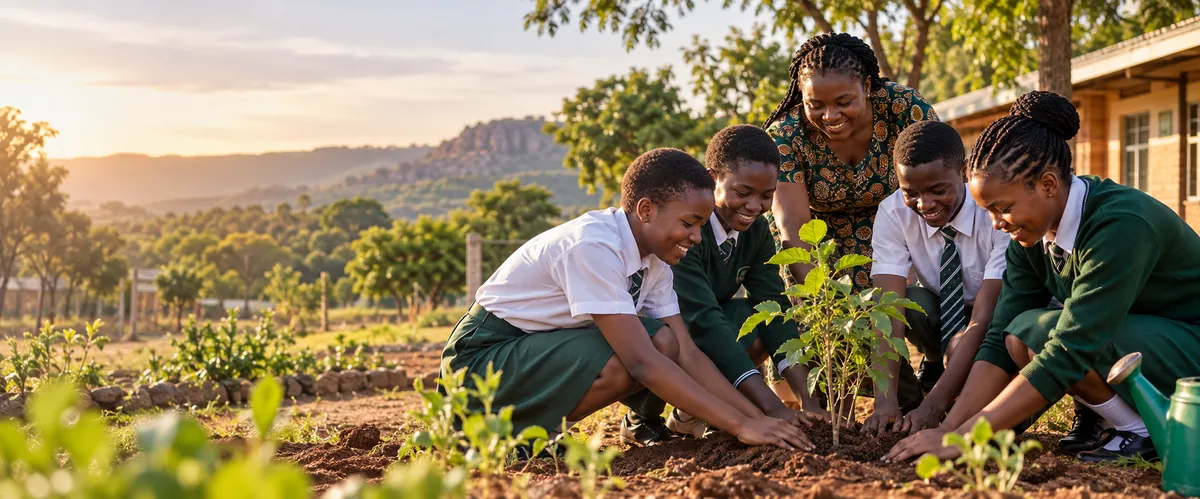
A possible six-step school journey
The six-step operating cycle follows the version 1.1 Ministry concept proposal. It is club-led, teacher-supervised and evidence-based; formal registration and school selection depend on appropriate approvals.
Establish a club
Register the school when authorised, nominate a teacher coordinator and organise supervised student teams.
Assess local needs
Record the starting position for trees, waste, water, energy and local conservation needs.
Select and approve projects
Choose two or three locally relevant programs; define project plans, responsibilities, safety, resources and measures.
Implement and document
Carry out school-term activities; record observations, photos and measurements with appropriate permissions.
Validate outcomes
Use teacher review and selected independent checks to confirm reported environmental results.
Recognise and improve
Score fairly, showcase achievements, maintain projects and improve the next school cycle.
A future digital reporting layer
The proposed digital platform would be mobile-first, low-bandwidth and capable of offline use. Students could document project work; teachers validate evidence; schools manage clubs; districts and provinces coordinate reviews; Ministry users view aggregated reports; and specialists receive only restricted authorised access. Role-based security, parental permission and audit trails are essential. Integration with SaviSchools is optional and subject to institutional approval.
Work that cannot be automated away
On-the-ground teacher guidance, project safety, school approval, local environmental expertise and independent verification remain necessary, regardless of the technology used.
Indicative phased implementation, not an agreed schedule
- Months 0–3: design, curriculum mapping, Ministry focal point, approvals, safeguarding and measurement rules.
- Months 4–9: possible 50–100-school supervised pilot, club formation, baselines, projects and digital reporting.
- Months 10–12: review verified results, project showcases and evaluate pilot lessons.
- Year 2 onward: consider phased expansion, sponsorships and separate carbon-credit feasibility screening.
The 50–100-school figure, timelines and possible inclusion of Mashonaland West are only planning assumptions. No school has been promised inclusion.